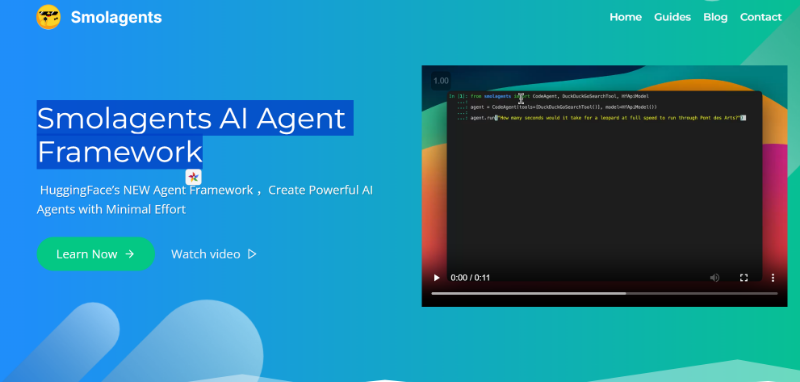
Smolagents AI Agent Reviews
(Rated by 10 users)
Are you looking for ways to save money when shopping at Smolagents AI Agent. Our Smolagents AI Agent coupon codes can help you do just that! Over 10 customers have already used our coupons to save an average of $69 with Smolagents AI Agent discount codes. There are currently 6 coupons available, so now is the perfect time to join in on the savings.
Are you looking for ways to save money when shopping at Smolagents AI Agent. Our Smolagents AI Agent coupon codes can help you do just that! Over 10 customers have already used our coupons to save an average of $69 with Smolagents AI Agent discount codes. There are currently 6 coupons available, so now is the perfect time to join in on the savings.
Payment Methods
- Verified Store VERIFIED
- Free shipping: Orders $50+
- In-store pickup: Ready in 2 hours
- 30-Day Returns
- Gap Good Rewards (4 brands)
Payment Methods
- Tops: $23 - $70
- Bottoms: $27 - $70
- Outerwear: $34 - $70
- Kids: $29 - $75
Overall Rating
4.4
Base on 10 Reviews
Ratings by Feature
Ratings by Feature
- Customer Service4.6
- Good Value4.5
- Price & Quality4.4
Recent Customer Reviews (10)
Madison Wong
View replies
Carolin Gauna
View replies
Yasmin Mann
View replies
Harry Flynn
View replies
Bryan Pitts
View replies
David Topper
View replies
Phillipp Ziegler
View replies
Yasmin Daly
View replies
William Garcia
View replies
Frank Probst
View replies
Smolagents AI Agent Pros & Cons
Pros
1
Simplicity and Minimalism: smolagents offers a lightweight, minimalistic framework with low code complexity and few abstractions, making it easy to understand, adopt, and extend for developers at all levels.
2
Code-First Agent Support: It uniquely supports "code agents" that write actions directly as executable Python code snippets rather than JSON or text blobs. This approach simplifies tool calling and improves efficiency in task execution.
3
Wide LLM Compatibility: The framework integrates seamlessly with various large language models (LLMs), including Hugging Face models, OpenAI models, Anthropic, and others via LiteLLM integration. This flexibility allows users to choose their preferred LLM backend.
4
Quick Setup & User-Friendly Interface: Developers can define agents with minimal configuration or boilerplate code. The interface is designed to be intuitive for both beginners and experienced users.
5
Integration with Hugging Face Hub: Deep integration enables sharing and loading tools from the Hugging Face Hub as well as using Gradio Spaces as tools. This fosters collaboration and easy access to community resources.
6
Secure Execution Environments: Supports sandboxed environments (e.g., via E2B) for safe execution of generated code by agents, enhancing security when running dynamic Python snippets.
7
Enhanced Efficiency: Direct execution of generated Python code reduces latency and improves performance compared to traditional agent frameworks relying on JSON/text action outputs.
8
Greater Flexibility: Ability to handle complex logic dynamically through generated code allows agents to perform a wider range of sophisticated tasks effectively.
9
Leverages LLM Strengths in Coding: Since large language models are extensively trained on coding data, smolagents capitalizes on this proficiency leading to more accurate and reliable agent behavior.
10
Lightweight & Minimalistic Framework: Ideal for quick experimentation without complex setups; perfect when application logic is straightforward but robust AI agent functionality is needed.
CONS
1
Best Suited for Simple Applications: smolagents is ideal when application logic is straightforward; it may not be the best choice for highly complex workflows or enterprise-grade agent orchestration requiring advanced features beyond its minimalist design.
2
Limited Abstractions May Restrict Advanced Use Cases: While simplicity is a strength, the minimal abstraction layer might limit flexibility or scalability in very large projects where more sophisticated agent management frameworks are needed.
3
Relatively New Framework: As a newer library succeeding transformers.agents (which will be deprecated), it may have less mature ecosystem support compared to older frameworks.
Smolagents AI Agent Features and Benefits
Features
Simplicity and Minimalism
lightweight, minimalistic framework with low code complexity and few abstractions, making it easy to understand, adopt, and extend for developers at all levels; clean, concise codebase (~1,000 lines); quick setup without elaborate configuration or boilerplate code; user-friendly interface suitable for beginners and experienced developers.
Code-First Agent Support
supports 'code agents' that write actions directly as executable Python code snippets rather than JSON or text blobs; simplifies tool calling and improves efficiency in task execution; reduces the number of steps and LLM calls by about 30%; enhances efficiency by reducing latency and improving performance compared to traditional agent frameworks.
Wide LLM Compatibility
integrates seamlessly with various large language models (LLMs), including Hugging Face models, OpenAI models, Anthropic, and others via LiteLLM integration; flexibility allows users to choose their preferred LLM backend; seamlessly integrates with any LLM hosted on Hugging Face Hub via Transformers.
Quick Setup & User-Friendly Interface
developers can define agents with minimal configuration or boilerplate code; intuitive for both beginners and experienced users.
Integration with Hugging Face Hub
deep integration enables sharing and loading tools from the Hugging Face Hub as well as using Gradio Spaces as tools; fosters collaboration and easy access to community resources.
Secure Execution Environments
supports sandboxed environments (e.g., via E2B) for safe execution of generated code by agents, enhancing security when running dynamic Python snippets.
Code-First Approach
emphasizes direct generation of executable code which simplifies tool calling mechanisms by removing the need for parsing intermediate formats; leverages LLM strengths in coding for more accurate and reliable agent behavior; allows handling complex logic dynamically for greater flexibility.